
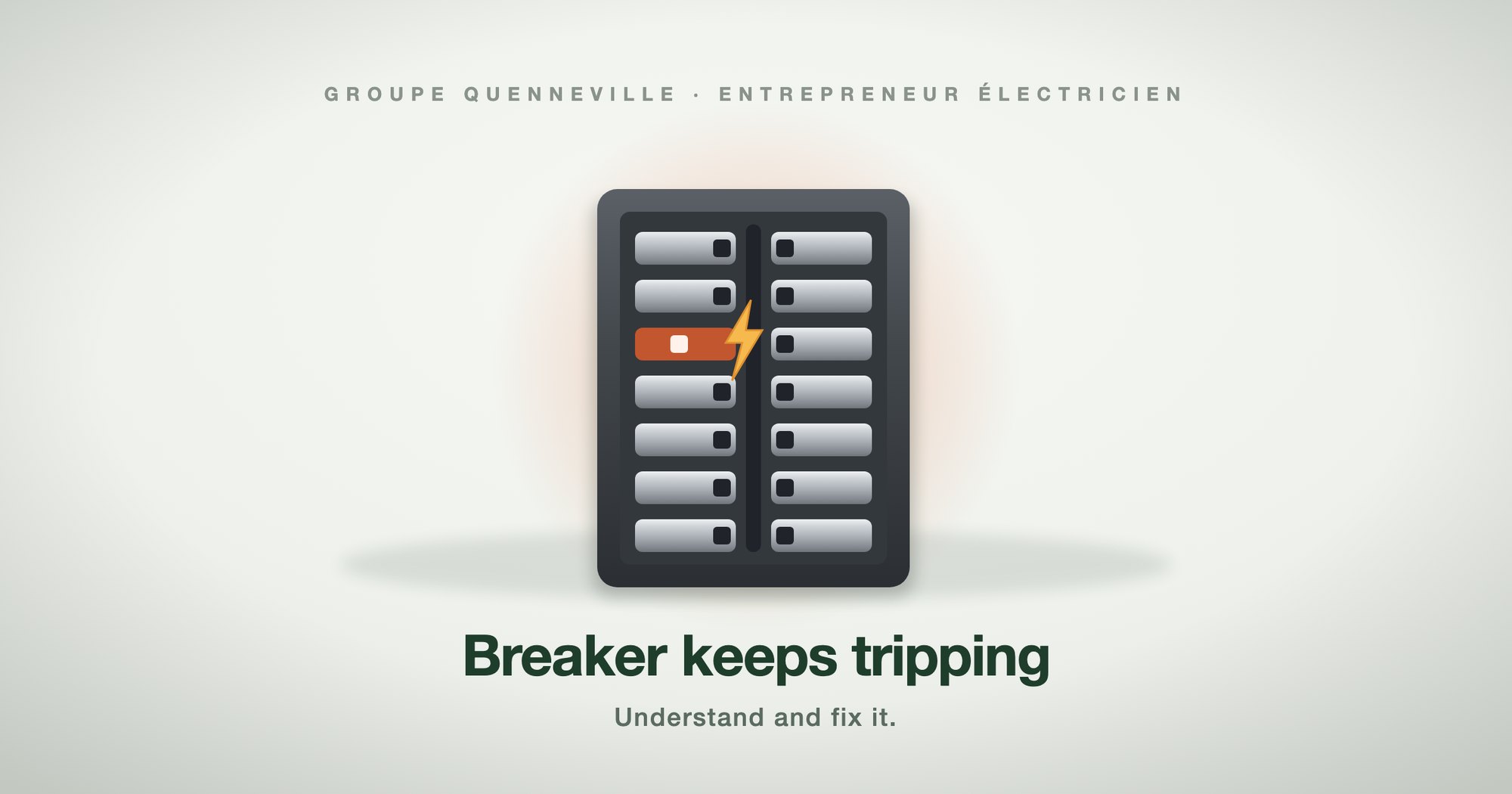
You start the microwave while the kettle heats up and — pop — half the kitchen goes dark. Frustrating, yes. But nine times out of ten, your breaker just did exactly what it exists to do. Here’s how to understand why it trips, what to do right away, and when it’s a real warning sign.
Your breaker isn’t glitching — it’s doing its job
You run the microwave while the kettle boils and, just like that, part of the kitchen goes dark. Annoying — but in most cases, your breaker just protected you from a fire. It cuts power the moment a circuit draws more than the wire can safely carry.
The real issue isn’t that it trips — it’s understanding why. Sometimes it’s harmless (too many appliances in one spot). Sometimes it signals a serious wiring problem. Here’s how to tell the difference, what to do on the spot, and when to pick up the phone.
Why a breaker trips
Almost every trip comes down to one of these three situations.
Overload
By far the number-one cause. Too many appliances draw power on the same circuit at once. Two heating appliances on one line (space heater + toaster, hair dryer + hot plate) and you exceed the limit. The breaker cuts out before the wire overheats.
Short circuit
A live wire touches a neutral or ground directly. Current spikes instantly. Often a sharp, loud “snap,” sometimes a spark or a smell. More serious — it comes from a faulty appliance, a damaged wire or a worn-out outlet.
Ground fault
Current “leaks” where it shouldn’t — often toward water or metal. This is what GFCI outlets detect (bathroom, kitchen, outdoors). The trip protects against electrocution, not just fire.
What to do, step by step
- Turn off or unplug whatever was running when it tripped (the “one too many” appliance).
- Find the breaker at the panel: it’ll be at OFF or stuck in the middle, usually the only one out of line with the others.
- Reset it firmly: push it all the way to OFF first, then to ON. A half-push won’t re-engage it.
- Plug things back in one at a time. You’ll often find the culprit — and learn what not to run together.
- Trips again right away, even with nothing plugged in? Don’t force it. The problem is in the circuit or the appliance, not your usage. Time to call.
The small math that explains it all
Every circuit has a limit. A 15 A breaker safely carries about 1,440 W continuously (keeping a 20% margin), a 20 A about 1,920 W. The catch: appliances that heat are hungry. Look:
≈ 1,500 W
Space heater · kettle · hair dryer · portable cooktop
≈ 1,200 W
Microwave · toaster · coffee maker · iron
≈ 1,875 W
High-power hair dryer · some portable water heaters
Add two of these on the same 15 A circuit and you’re near or over the limit. That’s why the bathroom (hair dryer + heater) and the kitchen (toaster + kettle) are trip champions. The lasting fix usually isn’t “plug in less” forever — it’s adding a dedicated circuit.
When it’s no longer routine — call
These signs aren’t about usage. They point to a problem in the installation. Shut off the circuit and have it checked.
- The breaker (or the panel) is hot to the touch.
- A burning, hot-plastic or scorched smell near the panel or an outlet.
- The breaker trips with nothing plugged in on the circuit.
- Sparks, crackling or a buzz at the panel or an outlet.
- It trips more and more often, with no change in your habits.
- A GFCI or AFCI breaker that trips regularly (see below).
GFCI and AFCI: why they trip more often
Recent installations use specialized breakers, and that’s good news even if they trip more:
GFCI (ground fault)
Protects against electrocution. It watches for the slightest current leak to ground — hence its place near water (bathroom, kitchen, outdoors, garage). If it trips, it’s sometimes a wet or aging appliance.
AFCI (arc fault)
Protects against fire. It detects electrical arcs (a pinched wire, a loose connection, an extension cord crushed under furniture). Required in Quebec on most circuits since 2018. An AFCI that trips deserves a look at the source.
No, you don’t fit a “bigger” breaker
It’s the most dangerous false good idea: swapping a 15 A breaker that keeps tripping for a 20 A or 30 A “so it stops.” A breaker is sized to the wire’s gauge, not to your wishes. A 14-gauge wire (15 A) protected by a 30 A breaker is a wire that can overheat without ever tripping the breaker. That’s exactly how fires start inside walls.
The real fix, when a circuit is chronically overloaded, is to add one — dedicated to the hungry appliances. Clean, safe and Code-compliant.
A temperamental breaker? We find the cause
A CMEQ-certified company holding an RBQ licence, serving Greater Montreal, Laval, the North Shore, the Laurentians and Lanaudière. We diagnose exactly why a breaker keeps tripping and fix it at the source — cleanly and to Code.
A breaker that keeps tripping?
We find the real cause and fix it at the source. Clear quote, guaranteed work.
What people ask us
Why does my circuit breaker keep tripping for no reason?+
There’s always a reason — it’s just not visible. Three possibilities: an overload (even a brief one), a short circuit in an appliance or wire, or a ground fault. If it trips with nothing plugged into the circuit, the problem is in the wiring or the breaker itself: have it checked.
Is it dangerous if my breaker trips often?+
Tripping occasionally when you overload a circuit, no — that’s its job. But more and more frequent trips, a hot breaker, a burning smell or sparks are serious signs. They point to overheating or an arc in the installation, a common fire cause. Have it inspected without delay.
Can I install a bigger breaker so it stops tripping?+
No, and it’s dangerous. A breaker’s rating is set by the gauge of the wire it protects. A breaker that’s too big lets the wire overheat without cutting power — a direct fire risk. The right solution is to add a dedicated circuit, not to increase the breaker.
What’s the difference between a breaker tripping and a fuse blowing?+
Both protect the circuit the same way. A breaker resets (you push it back to ON); a fuse destroys itself and must be replaced. If you still have a fuse panel, it often signals an older installation that would benefit from being evaluated and, frequently, upgraded.
Why does my bathroom GFCI outlet trip?+
A GFCI detects a current leak to ground, common near water. An aging hair dryer, a damp appliance or a tired outlet can trip it. Unplug everything, reset it with the button, then plug devices back in one at a time. If it keeps tripping empty, the outlet or wiring is at fault.
Can a breaker become faulty with age?+
Yes. A breaker is a mechanical device: it wears out, especially after years of repeated trips or in a hot or humid environment. A breaker that no longer holds, feels soft, or runs hot should be replaced by an electrician — it’s a safety device, not a simple switch.
How do I know which appliance is tripping the breaker?+
Unplug everything on the circuit, reset it, then plug appliances back in one by one, waiting a few minutes between each. The one that trips it again is the culprit — or it reveals that the circuit is simply too loaded to run everything together.
How much does it cost to have a tripping breaker checked?+
At Groupe Quenneville, a regular visit is $150 travel plus $140/hr (1 hr minimum). In an emergency (burning smell, sparks), it’s $495 travel plus $255/hr. The diagnosis pinpoints the real cause — usage, appliance, wire or breaker — to fix the problem at the source.
