
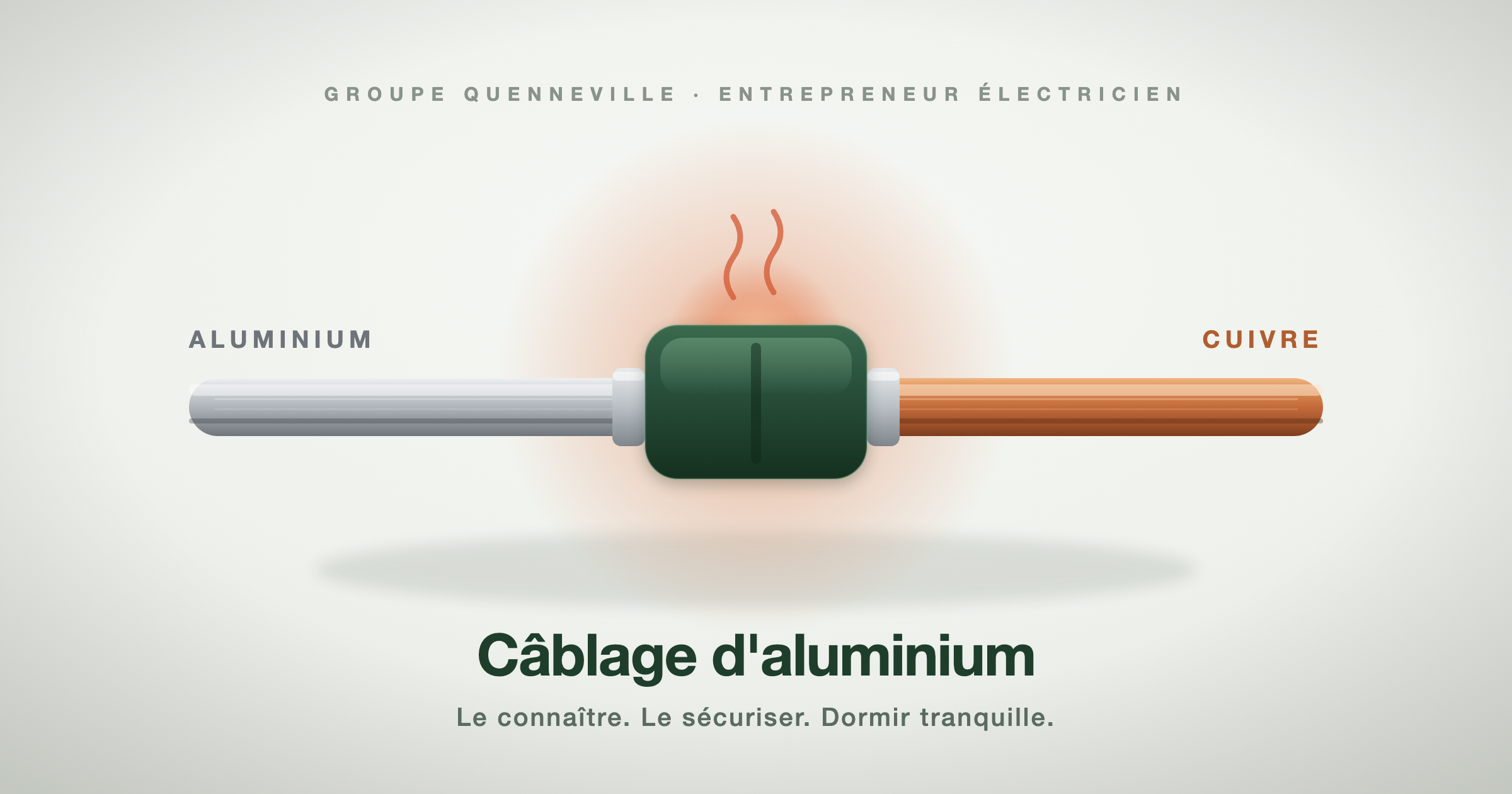
Was your home built between 1965 and 1975? Is your insurer asking for proof of inspection? Here’s everything you need to know about aluminum wiring — and your concrete options to be safe, without tearing everything out.
Thousands of Quebec homes are affected.
In the 1960s and 1970s, the high price of copper pushed the industry to wire tens of thousands of homes with aluminum. It was perfectly legal and compliant with the standards of the time. The catch: aluminum doesn’t age like copper. Over time, its connections can become a real hazard — and insurers know it. At Groupe Quenneville, we see this situation almost every week. Here’s the straight talk — no scaremongering, but nothing hidden.
The problem isn’t the wire.
It’s its connections.
At connection points — outlets, switches, panel — three phenomena add up and create invisible hot spots.
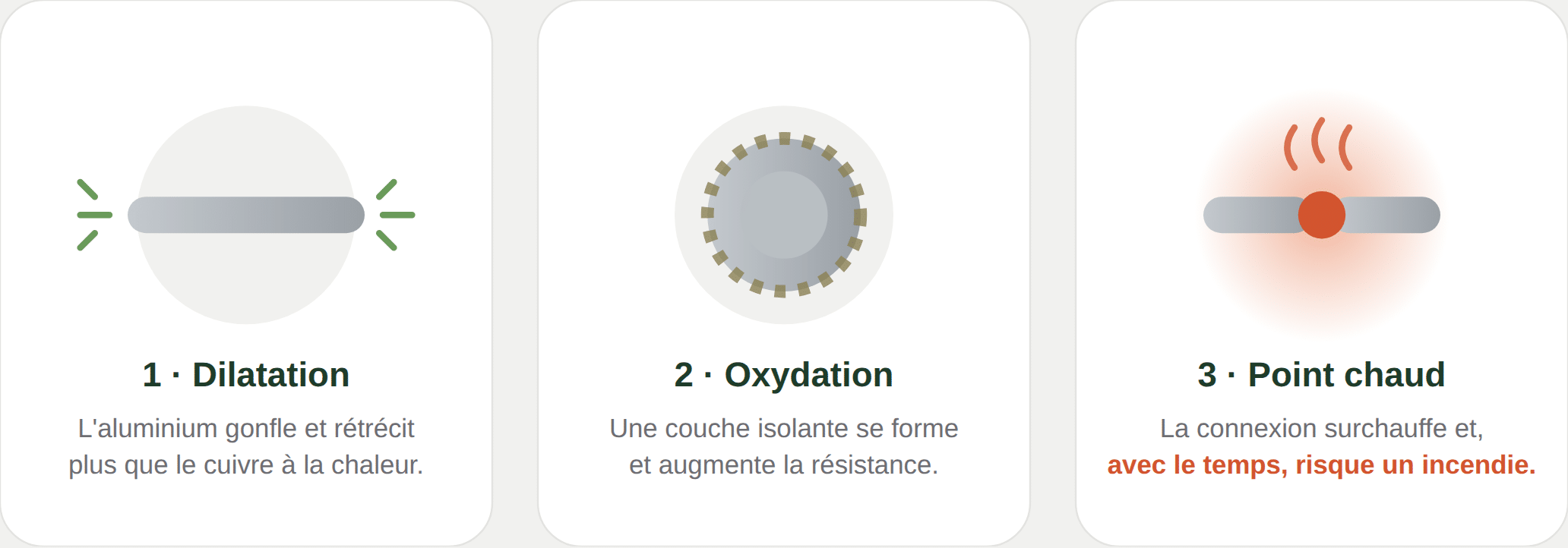
The aluminum wire itself isn’t the culprit: it’s the junction that’s the problem. A connection loosened by expansion, then insulated by oxidation, develops electrical resistance. This resistance generates heat exactly where you can’t see it — behind a wall plate, in a junction box, at the panel. That’s why an installation can look perfectly normal and still present a very real risk.
The warning signs
Some clues call for a quick check. But beware: the absence of symptoms guarantees nothing — many problem connections never warn you.
When it becomes a priority
You live there
Your home dates from 1965 to 1975. You simply want to make sure your family is safe. It’s the most responsible thing you can do.
Selling or buying
The pre-purchase inspection reveals aluminum. The buyer, notary or insurer requires a fix before closing. Good preparation keeps the deal from falling through at the last minute.
Insurance requirement
More and more insurers require recent proof of inspection or an upgrade report before renewing the home policy. Without that document, your coverage may be compromised.
Two paths. The good news: the simpler one is almost always enough.
Rewire in copper
We replace the circuits’ aluminum wiring with copper, today’s standard. The question never comes up again — not for you, not for a future buyer, not for the insurer. It’s the ideal choice during a major renovation, when the walls are already open. It’s also the most labour-intensive, so generally the most expensive; it’s quoted individually.
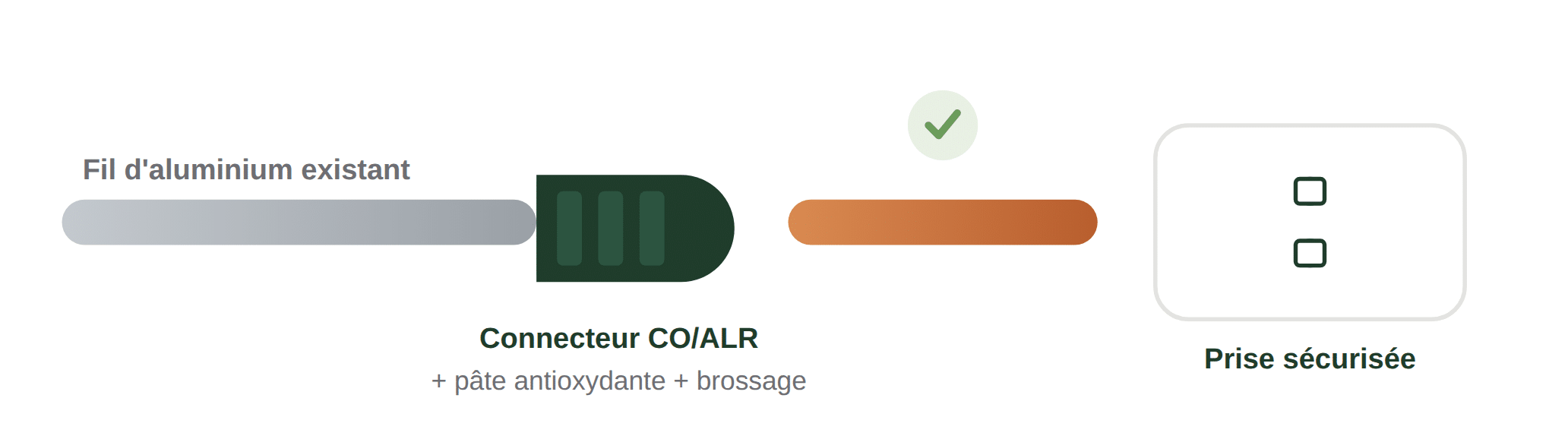
Certify and secure the connections
No need to tear everything out. We secure every connection point with approved connectors and methods (CO/ALR, copper pigtails, anti-oxidant paste), then inspect and issue a sealed certificate for insurance — exactly what insurers ask for. It’s the fastest, least invasive and most affordable route. It’s our specialty at Groupe Quenneville.
Nothing left to chance
Every component is checked according to the technical directives of the CMEQ and the RBQ. Meticulous work, designed for your safety.
| Equipment | Checks and procedures |
|---|---|
| 15 and 20 A outlets | Replaced with CO/ALR and copper pigtail. Wire brushing and anti-oxidant paste. |
| Switches | Replaced with CO/ALR and copper pigtail. Wire brushing and anti-oxidant paste. |
| Thermostats & heating devices | Torque check, conductor condition, copper pigtail if required and CO/ALR marking. |
| Accessible junction boxes | Visual inspection, CO/ALR wire connectors, anti-oxidant paste and wire brushing. |
| Electrical panel | Terminal tightening, inhibitor compound on the line side, verification of ratings (#12 → 15 A; #10 → 20 A). See our electrical panel service. |
| Light fixtures | Check of connections and copper/aluminum approval; connections redone as needed. |
Our pricing, no surprises
The cost varies with the amount of wiring and the number of components to check. Here are our reference rates for a certification and upgrade job.
As a guide: apartments generally fall between $1,000 and $2,000, while a house often exceeds $3,000 to $4,000, depending on the number of components. A full copper rewire is quoted separately. The most accurate way to know your real cost is a personalized, no-obligation quote.
An electrical company that knows the field
A residential, commercial and industrial electrical company, we’re your electrician in Montreal and across the entire North Shore, up to Sainte-Agathe-des-Monts. We guide you from A to Z: inspection, an honest recommendation between the two options, work done by the book, and issuance of the certificate.
One inspection. Peace of mind.
A 1965-1975 home, a sale to prepare, or an insurer requiring it: don’t let the aluminum wiring question drag on. Request your free quote today.
What homeowners ask us
Is aluminum wiring illegal?+
No. It complied with the standards of its time and it’s not illegal to keep it. However, it must be secured and often certified to satisfy your insurer.
Do I have to rewire everything?+
In the vast majority of cases, no. Certifying and securing the connections (CO/ALR connectors, copper pigtails, anti-oxidant paste) is enough to make the installation safe and acceptable to insurers.
How much does it cost to secure aluminum wiring?+
For a certification job, expect generally between $1,000 and $4,000 depending on the number of components: $1,000 to $2,000 for an apartment, often $3,000 to $4,000 for a house. A free quote gives you the exact figure.
Does it meet official standards?+
Yes. Our methods follow the technical directives of the CMEQ and the interpretations of the RBQ: Cu/Al connectors, copper pigtails, anti-oxidant paste, terminal tightening and rating checks.
Does Groupe Quenneville serve my area?+
We serve Montreal and the North Shore up to Sainte-Agathe-des-Monts. Contact us to confirm your area.
Sources: CMEQ – BTI-013 (Joining aluminum conductors) · CMEQ – Home verification guide · RBQ – Quality control guide for electrical installation work.
