
You plug something in and… nothing. Before picturing a big repair: in most cases, a “dead” outlet is fixed by a RESET button at the other end of the house. Here’s the reflex and the full checklist.
A dead outlet is (often) just a button to reset
You plug in the charger, the vacuum or the toaster… and nothing. Before imagining the worst, know that the most common cause of a “dead” outlet is a simple button to reset — often on another outlet, at the far end of the house. We’ll show you the reflex that solves it 6 times out of 10, the full checklist, and the signs that do call for an electrician.
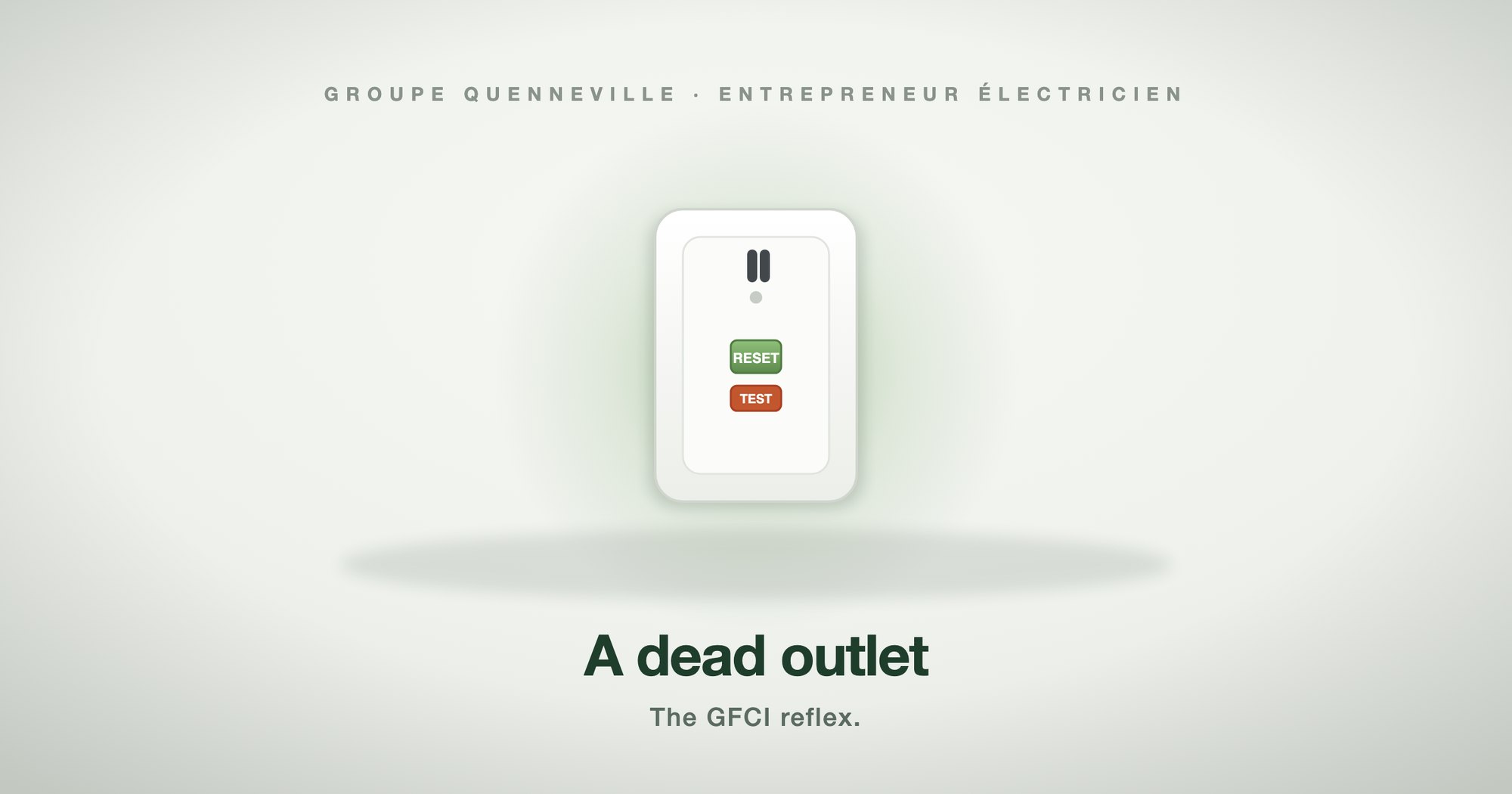
The GFCI RESET button
The ground-fault breaker (GFCI) protects areas near water. When it trips, it cuts power — not just to itself, but to every outlet it protects.
Locate it
An outlet with TEST and RESET in the middle. Check the bathroom, kitchen, garage, outdoors and basement — even if the dead outlet is elsewhere.
Reset it
Press RESET firmly until it clicks. The button had likely popped out. Then test the dead outlet.
Trips again?
Unplug everything and try once more. If the GFCI trips even empty, an appliance or the wiring is faulty — stop there and have it checked.
Troubleshooting in the right order
- Test another device in the outlet — and the suspect device in a working outlet. Rule out a false alarm.
- Check the panel. A breaker in the middle or at OFF? Reset it firmly (full OFF, then ON).
- Find and reset every GFCI in the house, not just the nearest one.
- Is the outlet switch-controlled? In many living rooms, a half-outlet turns on with a wall switch — that’s not a fault. Try the room’s switches.
- Still nothing? The problem is almost always a loose connection behind the outlet. That’s not fixed blind — time to call.
Why an outlet stops working
A tripped GFCI upstream
The champion. An “ordinary” outlet fed by a GFCI located elsewhere goes down with it.
A tripped breaker
Overload or fault on the circuit. The outlet is part of the group that was cut.
A loose connection (backstab)
The wire pushed into the outlet’s rear hole loosens over time. The #1 cause of intermittent outlets — and a real overheating risk.
A worn or oxidized outlet
After 30-40 years, the internal contacts loosen. The outlet “drops” plugs, runs hot, or dies.
Here, you don’t tinker — you call
These signs point to a heating connection or a fault. Cut the circuit at the panel and have it checked.
- The outlet or its plate is hot, yellowed or blackened.
- A burning smell or hot plastic comes from it.
- It crackles, buzzes or sparks when you plug in.
- Power comes and goes with the plug’s position.
- Several outlets die at once with no GFCI or breaker tripped — often a loose neutral to fix quickly.
“Push-in” outlets (backstab)
Many outlets connect two ways: the wire screwed onto the side terminal (solid), or pushed into a small hole at the back (fast, but fragile). That “push-in” connection is held only by a metal tab. Over years of heating and cooling, it loosens — hence outlets that die, flicker or heat up. When we replace an outlet, we always re-terminate on the screws. It’s the kind of invisible detail that separates a repair that lasts from a hot spot that comes back.
Replacing an outlet yourself: trickier than it looks
Swapping an outlet seems simple, and so are the mistakes: reversed polarity, missing ground, a loose wire, wrong gauge, or a circuit you thought was off but wasn’t. The result: shock and arc risk, plus non-compliance (a point that surfaces at a sale inspection). If the outlet is dead after the full checklist, or shows a warning sign, it’s a job for our team.
A dead outlet that resists? We fix it for good
A CMEQ-certified company holding an RBQ licence, serving Greater Montreal, Laval, the North Shore, the Laurentians and Lanaudière. We find the real cause — GFCI, breaker or loose connection — and re-terminate on screw terminals, so it lasts.
An outlet that won’t come back?
We diagnose and repair — cleanly, to Code. Clear quote.
What people ask us
My outlet stopped working — where do I start?+
First, test another device to rule out a faulty appliance. Then look for a GFCI (an outlet with TEST/RESET buttons) in the bathroom, kitchen, garage, basement or outdoors, and press RESET. Also check the panel for a tripped breaker. These three moves solve most cases.
What is a GFCI outlet and how do I reset it?+
A GFCI (ground-fault circuit interrupter) protects areas near water by cutting power at the slightest leak. It has two buttons in the middle: TEST and RESET. To reset it, press RESET firmly until it clicks. A single GFCI outlet can feed several ordinary outlets, which all go dead when it trips.
Why are several outlets dead at the same time?+
Usually because they’re all protected by the same GFCI, which tripped, or the same breaker, which tripped. Reset them. If none is tripped and several outlets stay dead, it’s often a loose neutral in the circuit — fix it quickly, as it can overheat.
My outlet works intermittently — is it serious?+
Yes, it needs attention. An outlet that works only sometimes, especially if it changes when you wiggle the plug, points to a loose connection inside. Those loose contacts heat up and can arc or start a fire. Stop using it and have it checked.
Is a switch-controlled outlet a fault?+
No. In many living rooms and bedrooms, an outlet (or half of one) is wired to a wall switch to control a lamp. If an outlet seems dead, try the room’s switches before assuming a failure.
Can I replace a dead outlet myself?+
It’s a risky job without the right skills: reversed polarity, missing ground, a push-in connection that re-loosens, or a poorly cut circuit. These errors are common and can cause shock or fire, and they surface at a sale inspection. After the basic checklist, leave the replacement to an electrician.
Why is my outlet hot or blackened?+
It signals a loose connection or a worn outlet resisting the current and overheating. A hot, yellowed or blackened outlet, or one that smells burnt, should be cut at the panel and replaced without delay — it’s a common cause of house fires.
How much does an outlet repair cost?+
At Groupe Quenneville, a regular visit is $150 travel plus $140/hr (1 hr minimum), and an emergency is $495 plus $255/hr. We diagnose the exact cause — GFCI, breaker, connection or worn outlet — and repair on screw terminals so it lasts.
