
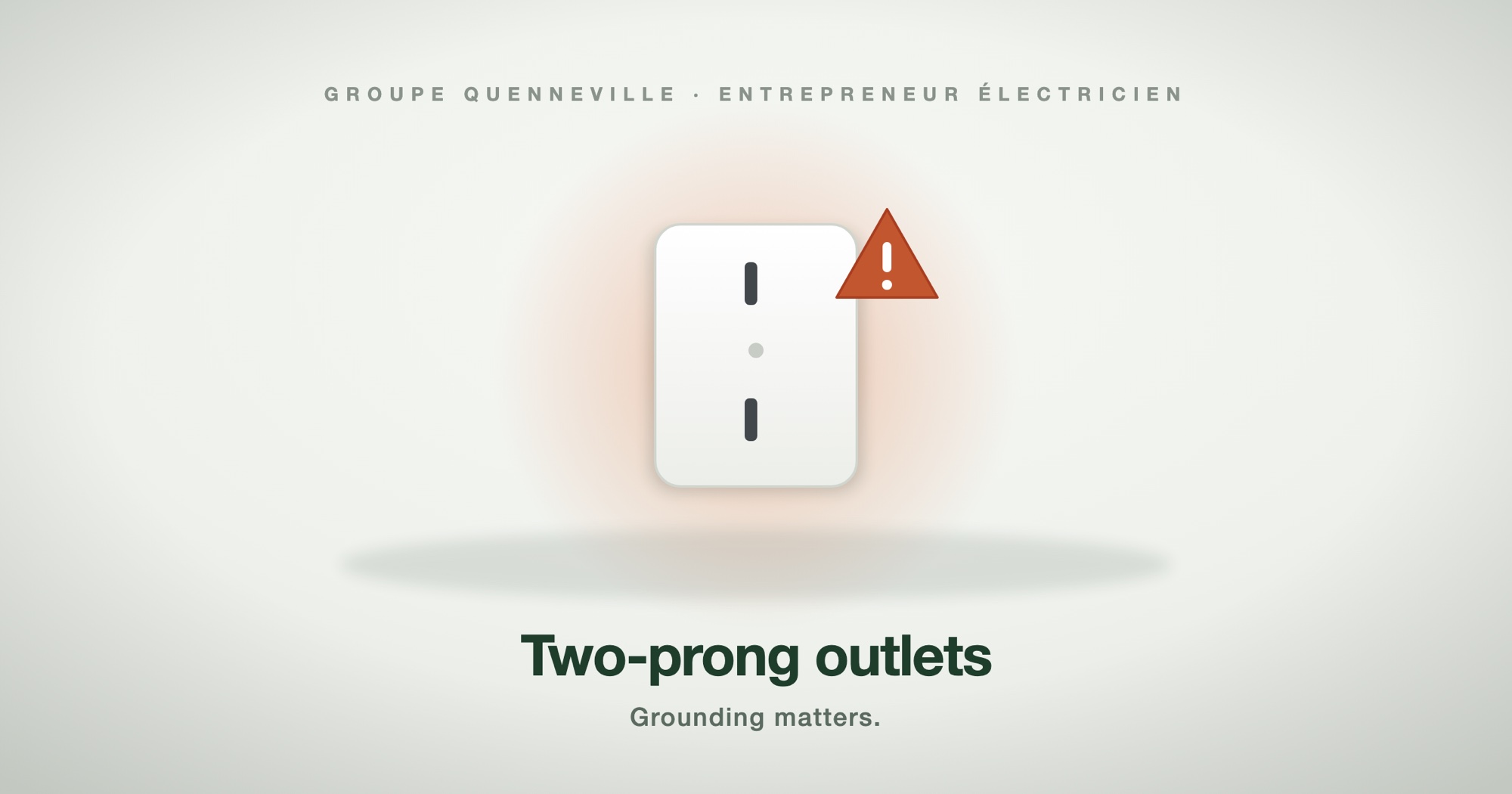
Your outlets have only two slots, no round hole at the bottom? That’s the sign a ground is missing. Here’s why it matters, the “solutions” to avoid at all costs, and how to fix it properly.
Two prongs = no ground
A two-slot outlet has no ground wire. That wire is electricity’s escape route: in a fault, it channels dangerous current to the ground instead of letting it pass through… you. Without it, a faulty appliance can become deadly to the touch.
The role of grounding
🛡️ Protects from shock
In a fault, it diverts current to the ground rather than to the person touching the appliance.
⚡ Clears faults
It lets the breaker “see” the problem and cut power quickly.
💻 Protects electronics
Computers, TVs and sensitive devices need a real ground to operate safely.
The dangerous fake fixes
- The 3-to-2 “cheater” adapter: it lets you plug in, but creates no ground. A false sense of security.
- Swapping in a 3-prong outlet… with no ground wire: illegal and deceptive. The outlet looks fine but doesn’t protect — worse than the original.
How to fix it by the book
- Run a real ground wire to the outlet — the ideal solution when accessible.
- Protect with a GFCI (breaker/outlet): the code allows, in renovation, replacing a two-prong outlet with a GFCI-protected one, labelled “no equipment ground.” It protects people against shock.
Where it’s most urgent
We prioritize wet and high-risk areas: kitchen, bathroom, outdoors, garage, basement, and outlets feeding valuable electronics. These are also often where the code already requires GFCI protection.
How to know if an outlet is properly grounded
There’s an inexpensive little tool: the three-light outlet tester (under $20 at the hardware store). You plug it in, and the light combination shows whether the outlet is correctly wired and grounded — or has a fault (missing ground, reversed polarity, etc.). It’s a good first reflex. But note: it won’t catch a sneaky “false ground.” When in doubt, a check by our team confirms the real situation.
What we upgrade at the same time
- GFCI outlets where required (kitchen, bathroom, outdoors, garage, basement).
- Tamper-resistant (TR) outlets — required in living areas: small shutters block access to objects, a safety for children.
- Outlets with built-in USB ports, handy for charging without a wall block.
Truly safe outlets
CMEQ-certified company holding an RBQ licence. We check your outlets, spot false grounds and fix them to code. Serving Greater Montréal, Laval and the North Shore.
Are your outlets safe?
We check the grounding and fix what needs fixing. Free quote.
Your questions about two-prong outlets
Is a two-prong outlet dangerous?+
It’s less safe because it has no ground: in an appliance fault, nothing channels the dangerous current away. The shock risk is real.
Can I just install a 3-prong outlet?+
No, not without a real ground wire: it would be illegal and deceptive. The outlet would look safe without being so — a frequent inspection finding.
Is the 3-to-2 adapter safe?+
No. It lets you plug in but creates no ground. It’s a false sense of security.
What’s the right way to fix it?+
Run a real ground wire, or — in renovation — replace with a GFCI-protected outlet labelled “no equipment ground,” per the code.
Which outlets should I start with?+
Wet, high-risk areas (kitchen, bathroom, outdoors, garage, basement) and those feeding valuable electronics.
How do I test an outlet?+
With a three-light outlet tester (under $20): it reveals whether the outlet is well wired and grounded. It won’t always catch a false ground, so have it checked professionally if in doubt.
Are outlets with USB ports worth it?+
Yes, for convenience: charge phones and tablets without a wall block. Best in the kitchen, office and by beds.
What is a tamper-resistant (TR) outlet?+
An outlet with internal shutters that block object insertion. Required in living areas, it mainly protects young children.
